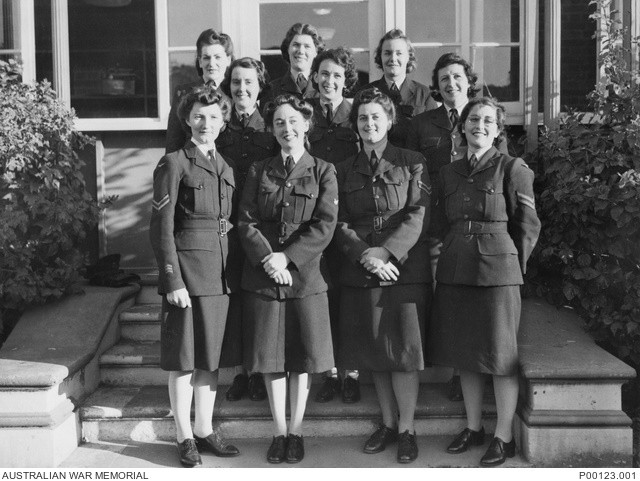
During World War 2, a team of Australian codebreakers worked day and night to intercept and decode Japanese messages. They were young, female, and worked in a shed.
Young Lorna McLean, later to become the mother of two Kent Street alumni students, was one of these dedicated Australian women.
She was handpicked to work for the Central Bureau, a highly classified, joint Australian-American signals intelligence organisation established in Melbourne (and later moved to Brisbane) — Australia’s answer to Bletchley Park.
Alongside her fellow operators, Lorna’s duties primarily revolved around interception, decoding, and translating highly sensitive Japanese military wireless traffic and war signals, as well as securing and encoding Allied transmissions.
Operating under a deliberately mundane name to avoid enemy attention, the Central Bureau served as the strategic “engine room” for US General Douglas MacArthur’s forces, playing a monumental role in dismantling Japanese military operations.
By late 1942, the Bureau had set up its primary base of operations at “Nyrambla”, a sprawling grand mansion located in the suburb of Ascot, Brisbane. It eventually grew from a handful of operatives to a massive network of over 4,300 personnel. Because of the intense workload, they spilled out from Nyrambla into the nearby Ascot Racecourse.
Meanwhile, the garage at Nyrambla was converted into a high-security hub housing twelve British Typex cipher machines. Operated around the clock by members of the Australian Women’s Army Service (AWAS), these women—affectionately known as the “Garage Girls”—painstakingly entered and decrypted raw intercepts.
The Central Bureau’s intelligence directly shaped the trajectory of the Pacific War, enabling the Allies to intercept and act on Japanese troop movements. Their most famous contributions included:
- The Death of Admiral Yamamoto — the Central Bureau intercepted and decoded the specific travel itinerary of Admiral Isoroku Yamamoto, the architect of the Pearl Harbour attack. This allowed U.S. fighters to ambush and shoot down his transport plane over Bougainville in 1943.
- Crucial Pacific Battles — Their breakthroughs delivered vital tactical warnings that altered the outcomes of the Battles of the Coral Sea, Midway, Milne Bay, Hollandia, and Leyte.
- First Contact — On 14 August 1945, after Japan offered its surrender, an Australian intelligence officer from the Bureau bypassed traditional channels to establish the Allies’ very first direct radio contact with Tokyo since the war began.
In 1946, shortly after the conclusion of her wartime service, Lorna married Royce Clark in Bunbury, Western Australia. As children, Lorna and Royce (who were the same age) had both lived for many years in the same street in Bunbury. Early in his life, Royce and another local resident were publicly honoured by Sir Talbot Hobbs in Bunbury for risking their lives to rescue three women from drowning.
Royce was now a Lieutenant in the Australian Navy (he’d first enlisted in 1934) and later became a prominent Western Australian musician, conductor, and military bandmaster. He began his brass band career in 1928 (aged only 10) as a champion soprano cornet player for the Bunbury City Band.
After moving to Perth following his marriage to Lorna, Royce spent sixteen years as a member and conductor of the City of Perth Brass Band. In 1967, he became the inaugural Musical Director of the Canning Civic Band (now known as the Canning City Brass Band), a post he held until his retirement in 1980.
Because of the strict Official Secrets Act that all Central Bureau personnel signed, the immense contributions of women like Lorna remained entirely hidden from the public—and often even their own families—for decades after the war concluded.