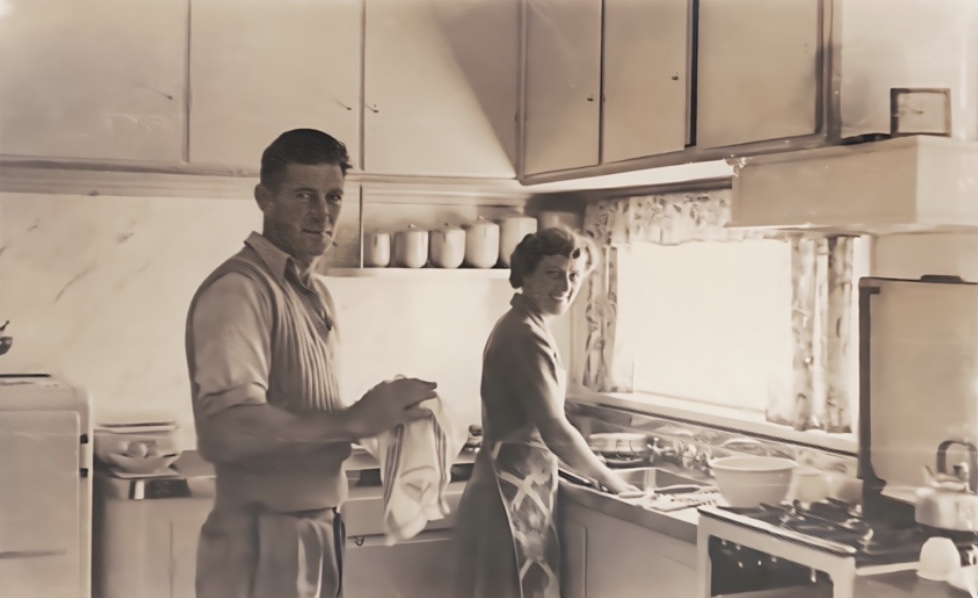
When Ken Stewart was demobilised from the Australian Army after World War 2, he bore both the physical and economic scars of a nation at war.
Ken had first enlisted in 1937 as a 21-year-old in the 15th Light Horse regiment based in northern NSW. Six years later, in 1943, his Army career led him to Western Australia when his now mobilised regiment travelled by train to the State.
Ken attended dances in Perth during his periods of leave and at one such event a shorthand typist named Irene Palmer caught his eye. After announcing their engagement in late 1944, Ken headed to Northern Queensland two months later to take part as a volunteer in high-risk malaria experiments for the Army.
When Ken returned to civilian life upon his discharge from the Army in December 1945, soon after marrying Irene, he had little more than an accrued back pay of 120 pounds.
Jobs were scarce forcing him to initially craft wooden toys for Perth shops just to make ends meet while he searched for stable employment. The young couple ended up residing with Irene’s family in Carlisle for the first six years of their married life.
Ken’s primary mechanism for coping and rebuilding his future was through relentless hard work and resourcefulness. Securing work as a carpenter, he frequently “went bush” to build houses across regional Western Australia.
However, his transition was severely complicated by recurring bouts of malaria—a direct legacy of his wartime service in Queensland. In 1946, the illness hospitalised him, and though declared “cured” after a two-week medical stint, the threat of recurring health issues remained.
Rather than yielding to post-war scarcity and hardship, Ken channelled his determination into establishing stability. Utilising his back pay, he made two foundational investments that defined his family’s future: two blocks of land on Westminster Street in East Victoria Park (costing 40 pounds each) and a Singer sewing machine (42 pounds).
Working tirelessly on weekends and before and after long shifts as a builder, Ken manufactured his own timber mould to pour 40 concrete stumps by hand, eventually erecting a modest, self-built home to shelter his new bride, Irene, and later their daughter Kaye.
His ingenuity—visible in custom-built home contraptions, brick-laying, and repeated stints working in harsh regional conditions—allowed him to overcome the financial and material shortages of post-war Australia. This unyielding work ethic ultimately paved the way for his later success as a master builder and business owner, transforming a veteran’s struggle into a lasting family foundation.