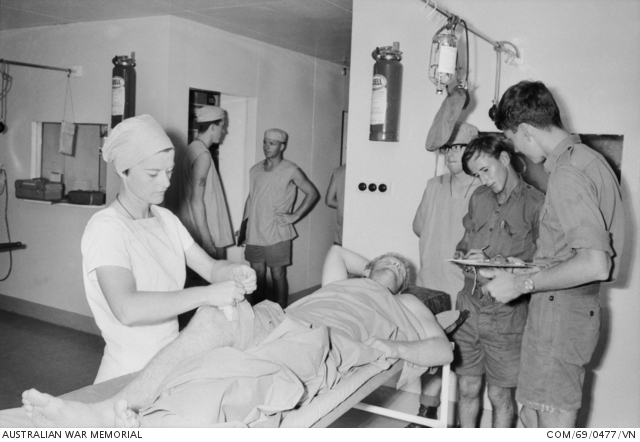
Some of the bravest Australians to serve their country never carried a gun. Instead, they carried bandages, scissors, and a deep sense of care.
Born in Perth in 1937, alumni student Yvonne Werndly was an exceptionally well-travelled and experienced nursing sister before she ever put on an army uniform. She had already nursed across three Australian states, Port Moresby, England, and Bermuda.
Seeking further opportunities to travel and serve, she spent two years with the Citizen Military Forces (CMF) before officially joining the Royal Australian Army Nursing Corps (RAANC) in October 1967. Following a posting at the 1st Military Hospital in Yeronga, Queensland, she volunteered for deployment to South Vietnam, arriving on 21 May 1969.
Lieutenant Werndly was stationed at the 1st Australian Field Hospital (1AFH) in Vung Tau during a period of intense conflict. Serving as a highly skilled theatre sister, her daily life was a stark contrast of extremes.
Archival records and photographs capture her snatching brief moments of respite, swimming in the South China Sea after work, only to be called back by sirens echoing across the beach the moment a combat ‘contact’ occurred. Off-duty staff would immediately flood the hospital to manage the influx of casualties.
Because iconic “Dust-off” helicopters—including the famous “Band-Aid Special”—slashed transit times by lifting wounded soldiers from the jungle to the hospital in under an hour, nurses were flooded with patients who would have previously died on the battlefield.
Working in triage and operating theatres, Yvonne and her fellow nurses faced unimaginable pressure. They treated horrific injuries caused by shellfire, explosions, gunfire, and anti-personnel mines—trauma so severe that in normal civilian life, these patients would have been deemed untreatable and died before ever reaching a hospital.
While some wounds were obvious, others required meticulous care; nurses had to carefully remove shell fragments, mud, and debris just to find tiny, life-threatening perforations in a soldier’s abdomen.
Yvonne’s role was fast-paced and high-stakes. She had to rush through initial assessments, precisely treat traumatic mine and blast injuries, and prepare soldiers for emergency surgery—often within just 20 minutes of them being wounded.
Despite the severity of the wounds, the survival rate was very high in South Vietnam – only 2.6% of hospitalised soldiers died. This was about half the mortality rate of World War II.
However, the physical and psychological toll on these young women was immense. They worked tirelessly to save “their boys,” but witnessing the trauma of triage and sharing the final, harrowing moments of dying soldiers left lasting scars.
As one veteran nurse later reflected: “That act of helping someone is more intimate than anything, and once you have done that, you can never be ordinary again.”