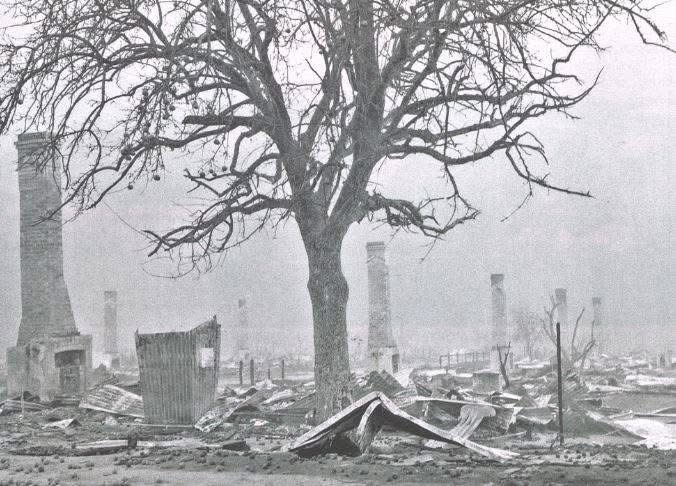
Towns were destroyed, hundreds left homeless and a Royal Commission called.
In January 1961, six days of bushfires ravaged thousands of hectares of jarrah forest around Dwellingup, a Forestry Department stronghold 110km south of Perth.
Dry lightning had ignited multiple blazes that spread rapidly through heavy fuel loads. The fires were driven by catastrophic weather conditions, with temperatures exceeding 40°C, cyclonic winds, and massive crown fires that overwhelmed standard containment lines.
The fires destroyed most of Dwellingup—homes, businesses, farms, the hospital—and soon consumed the mill towns of Marrinup, Nanga Brook, and Holyoake.
Miraculously, no lives were lost, though some 160 buildings were destroyed at an estimated cost of $35 million.
The disaster prompted a Royal Commission whose 27 recommendations— including prescribed burning reforms—reshaped bushfire management across Australia, making the event a defining lesson in preparedness.
The Royal Commission found that rural firefighting in Western Australia had for many years been largely ad-hoc, run on a shoestring budget, and lacking any cohesive structure. If this had still been the case at the time of the Dwellingup fires, the result could have been much worse.
Instead, it was realised that ex-servicemen had returned to the land, following World War II, with a deeply ingrained understanding of regimental chain-of-command, resource coordination, and large-scale logistics.
They’d applied these military principles to local bushfire brigades, implementing systematic communication structures and organised team frameworks, an organisational shift that proved critical when defending against the catastrophic fires at Dwellingup.
The battle-tested discipline and situational awareness of these ex-servicemen allowed volunteer crews to remain composed under severe threat. This operational calm and execution of orderly tactics is widely credited as a major reason why, despite six local towns being heavily damaged or completely erased, no human lives were lost.
One of those ex-servicemen was 50-year-old mechanic Reg McLean, uncle of two alumni students of Kent Street SHS, who was in Dwellingup townsite the night the fire destroyed the town.
Reg was interviewed soon afterwards for an ABC TV news broadcast. His gripping first-hand account recounts how hundreds of local residents sought refuge on the barren ground of the local school hill and the town oval, watching the world burn around them.
He starts the interview by first praising the immense bravery of forestry workers and volunteer brigades who faced down the flames with rudimentary equipment, spraying water on everyone as the fire swept through.
“They kept their heads, and they kept us all together. They took us up onto the hill, and we just had to lie down there on the rocks and the gravel and take it.
The heat was intense. You could feel your clothes scorching on your back. We had a few wet bags and blankets, but they dried out almost as soon as you put water on them.
The smoke was so thick you couldn’t see a [metre] in front of you. You just had to lie there with your face to the ground and breathe through a wet handkerchief, if you had one.
The roar of the fire was like a dozen express trains going through a tunnel. And every now and again, there’d be a terrific explosion as a petrol tank or a drum of distillate blew up.
It was a terrible night. I don’t think any of us expected to see the morning. But we came through it, thank God.”